Diabetes · Diet chart · Pakistani food · Nutrition Care
Sugar ke Mareez ka Diet Chart: Kya Khayen, Kaunse Fruit, Roti ya Chawal?

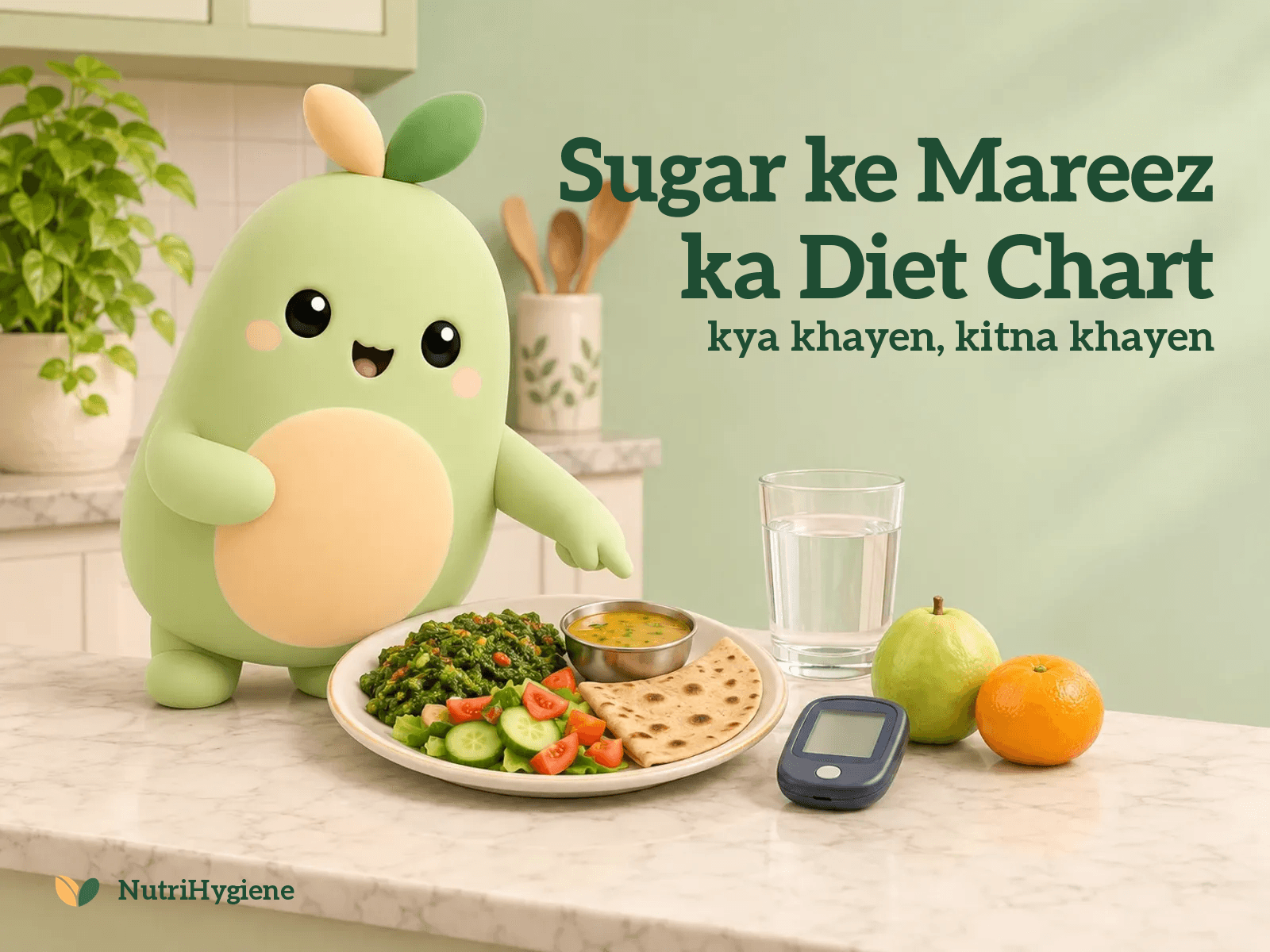
Short answer: sugar ke mareez (people with diabetes) don't need special food or to stop roti completely. The easiest rule is the plate method: fill half your plate with sabzi or salad, a quarter with protein like daal, chicken, fish or eggs, and a quarter with carbs like roti or chawal (CDC). Whole fruit is fine in portions, but fruit juice raises blood sugar faster than whole fruit (CDC). Cut down on sugar, mithai, cold drinks and maida, and never skip meals or stop your medicine without your doctor.
Pakistan has the highest rate of diabetes in the world: about 34.5 million adults live with it, according to the International Diabetes Federation's Diabetes Atlas (IDF). So if you or someone at home has sugar, you're far from alone. This guide uses everyday Pakistani food, with every number checked against official sources.
Sugar ke mareez kya khayen?
There's no single "diabetes diet" that works best for everyone. The American Diabetes Association says many eating patterns can work, and that what you eat should be planned around your needs, with less sugar and refined grains, more fibre and plant protein, and less saturated fat (ADA Standards of Care 2025, via NIDDK). The NHS gives the same simple advice: eat a varied diet with vegetables, fruit, wholegrains and pulses like chanay and daal, and limit foods high in sugar and salt (NHS).
In a Pakistani kitchen, that means:
| Eat more | Eat in a measured portion | Keep small and occasional |
|---|---|---|
| Sabzi: palak, bhindi, ghiya, tori, gobhi, karela | Chakki atta roti | Mithai, kheer, halwa, jalebi |
| Salad: kheera, tamatar, salad patta | Chawal (small plate) | Cold drinks and packet juices |
| Daal, chanay, lobia, rajma | Whole fruit (1 portion at a time) | Meethi chai with 2–3 spoons of sugar |
| Anda, chicken, machli | Aloo, shakarkandi | Maida: naan, white bread, bakery rusk |
| Plain dahi, raita (no sugar) | Khajoor, kishmish | Samosa, pakora, puri, paratha every day |
Diabetes plate: 1 plate ka asaan formula
Use a normal dinner plate (about 9 inches, 23 cm) and fill it like this (CDC):
- ½ plate: sabzi or salad. Any non-starchy sabzi, cooked with little oil.
- ¼ plate: protein. Daal, chanay, chicken, fish or eggs.
- ¼ plate: carbs. 1 roti, or a small portion of chawal.
- Drink: water, or chai without sugar.
Why it works: sabzi, daal and protein fill you up and add fibre, so the roti or chawal on your plate raises blood sugar more slowly than a full plate of chawal on its own.
Roti ya chawal: sugar mein kya behtar hai?
Both are carbohydrates, and both raise blood sugar. The difference is mostly how much you eat and how much fibre comes with it.
| Food | Portion | Carbs | Fibre |
|---|---|---|---|
| Chakki atta roti | 1 medium (30 g atta) | ~22 g | ~3 g |
| White rice, cooked | 1 small plate (150 g) | ~42 g | ~0.6 g |
| Brown rice, cooked | 1 small plate (150 g) | ~38 g | ~2.4 g |
| Daal (masoor), cooked | 1 katori (150 g) | ~30 g | ~12 g |
Calculated from USDA FoodData Central values per 100 g: whole-grain wheat flour (72 g carbs, 10.7 g fibre), white rice, cooked (28.2 g, 0.4 g), brown rice, cooked (25.6 g, 1.6 g) and boiled lentils (20.1 g, 7.9 g). Portions vary, so treat these as estimates.
What the table shows: one small plate of white rice has about the same carbs as 2 rotis, with far less fibre. A large study in BMJ also found that eating more white rice was linked to a higher risk of type 2 diabetes, especially in Asian populations (Hu et al., 2012).
Practical rule: have 1–2 chakki atta rotis per meal, or a small plate of chawal instead of roti (not both), always with sabzi and daal or protein. Brown rice or a roti made with a jau-gandum mix adds more fibre. See our guide to jau vs gandum ki roti.
Sugar ke mareez ke liye kaunse fruit?
Yes, people with diabetes can eat fruit. The CDC lists fruit as a carb food to count in your meal, and notes that fruit juice raises blood sugar faster than eating whole fruit (CDC). A large BMJ study found that eating more whole fruit such as apples and grapes was linked to a lower risk of type 2 diabetes, while more fruit juice was linked to a higher risk (Muraki et al., 2013).
| Fruit | Portion | Carbs | Fibre |
|---|---|---|---|
| Amrood (guava) | 1 medium (~100 g) | ~14 g | ~5.4 g |
| Malta (orange) | 1 medium (~130 g) | ~15 g | ~3 g |
| Kinnu (mandarin) | 1 medium (~130 g) | ~17 g | ~2.3 g |
| Papita (papaya) | 1 cup pieces (~140 g) | ~15 g | ~2.4 g |
| Seb (apple) | 1 medium (~180 g) | ~25 g | ~4.3 g |
| Kela (banana) | 1 medium (~118 g) | ~27 g | ~3 g |
| Aam (mango) | 1 cup slices (~165 g) | ~25 g | ~2.6 g |
| Angoor (grapes) | 1 cup (~150 g) | ~27 g | ~1.4 g |
| Khajoor, small | 1 date (~7 g) | ~5 g | ~0.6 g |
| Khajoor, large (Medjool/Ajwa size) | 1 date (~24 g) | ~18 g | ~1.6 g |
Calculated from USDA FoodData Central values per 100 g for guava, orange, tangerine, papaya, apple, banana, mango, grapes, Deglet Noor dates and Medjool dates. Fruit sizes vary.
Easy fruit rules:
- One portion at a time, not a full bowl. Spread fruit across the day.
- Eat it whole, don't drink it. Skip packet juices and fresh juice; Diabetes UK advises avoiding or cutting down on fruit juice and smoothies (Diabetes UK).
- Amrood, kinnu and papita give fewer carbs per portion. Aam, angoor, kela and khajoor are fine, just in a smaller portion.
- Pair fruit with protein, for example seb with a few badam, instead of eating it alone.
Sugar ke mareez ka diet chart (1 din ka sample)
This is an example built on the plate method, not a prescription. Your doctor or nutritionist should set your exact portions, especially if you take insulin or tablets like gliclazide.
| Meal | What to eat | Tip |
|---|---|---|
| Nashta | 1 chakki atta roti + 2 anday (omelette with little oil) + chai without sugar | Protein in the morning keeps you full |
| Mid-morning | 1 amrood or 1 kinnu | Whole fruit, not juice |
| Lunch | 1 katori daal + sabzi + salad + 1 roti | Half the plate sabzi |
| Evening | Chai without sugar + 1 mutthi bhune chanay | Instead of biscuits or samosa |
| Dinner | Chicken or fish salan (little oil) + sabzi + salad + 1 roti (or a small plate of brown rice) | Eat at a regular time |
Need more energy or are you losing weight without trying? Talk to your doctor. Many people with diabetes need more food than this, not less.
Don't skip meals. If you take insulin, or tablets such as gliclazide or glimepiride, skipping or delaying meals can cause low blood sugar (hypoglycaemia) (NHS).
Gur, shehad, khajoor aur sugar-free mithai: sach kya hai?
- Gur and shehad (honey): both are sugar. They don't count as a "safe" swap for cheeni in diabetes. Keep them small, like cheeni.
- "Sugar-free" mithai: it may have no added cheeni, but it's still made with khoya, maida, ghee or dry fruits, so it still has carbs and calories. Check the label and keep it small.
- Khajoor: fine in a small portion. One small date has about 5 g of carbs, but one large Medjool or Ajwa-size date has about 18 g, close to a roti's worth.
- Karela, methi dana and desi totkay: karela is a healthy sabzi, but no desi totka replaces your medicine. Never stop or change medicine on your own.
Activity: khana ke saath walk kitni zaroori hai?
The NHS advises at least 2.5 hours of activity a week, like brisk walking, for people with type 2 diabetes (NHS). That's about 30 minutes, 5 days a week. A 10–15 minute walk after lunch and dinner is an easy way to fit it in.
Low sugar (hypo) ho jaye to kya karein?
Low blood sugar is usually below 4 mmol/L (about 72 mg/dL). Signs include shaking, sweating, hunger, dizziness, a fast heartbeat and confusion (NHS).
If you're awake and can swallow, the NHS advises (NHS):
- Take something with fast sugar, like about 150 ml of fruit juice or a regular (not diet) cold drink.
- Check again after 10–15 minutes. If still under 4 mmol/L, repeat.
- Once it's above 4 mmol/L, eat a snack or meal.
If someone is unconscious, don't give food or drink. Get emergency help straight away.
Doctor se kab milna chahiye?
See your doctor if:
- your sugar stays high for several days, or you get low sugar often,
- you're losing weight without trying, are very thirsty, or pass urine a lot,
- you have a wound on the foot that isn't healing,
- you want to fast, start a strict diet or change your medicine.
Sugar mein khana kaise track karein?
The hardest part of a diabetes diet isn't knowing the rules. It's following them every day: one extra roti, a sweet chai at a relative's house, a plate of chawal at a shaadi. Research shows that people who regularly record what they eat do better at managing their weight (Burke et al., 2011).
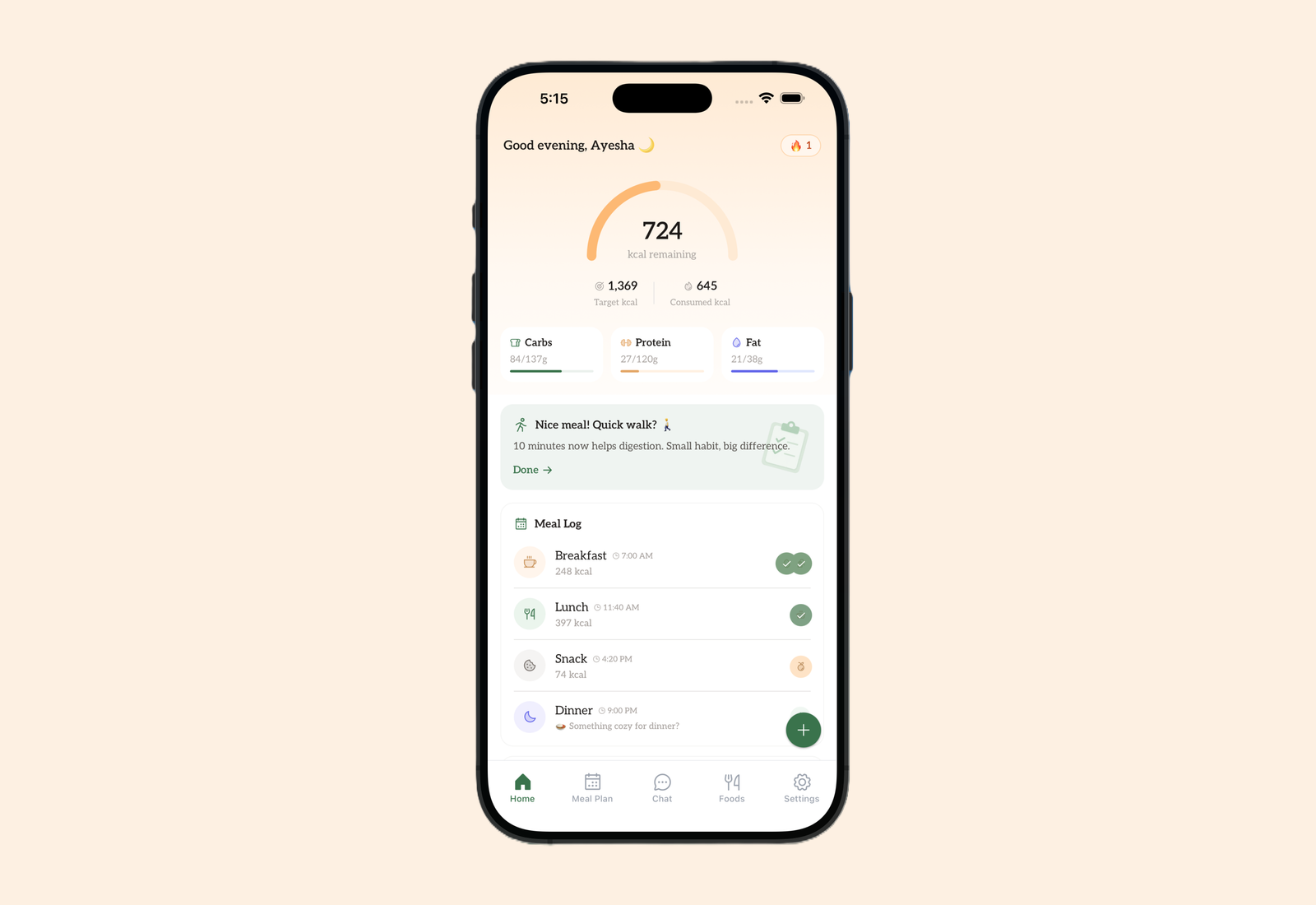
The NutriHygiene app helps you see your day clearly:
- Log Pakistani meals in your portions: roti, chawal, daal, salan, chai and fruit.
- See your carbs, protein, fat and calories for the day at a glance.
- Save combos and custom meals: "2 anday + 1 roti + chai bina cheeni" once, then log it in one tap.
- Log water and activity, including your walk after dinner.
Apne liye diet plan: pehle free consultation
Every person with diabetes needs a different plan. Your medicines, your sugar readings, your weight, and whether you cook for the whole family all change what's right for you.
With Nutrition Care in the NutriHygiene app, you start with a free guided consultation and health assessment. A nutritionist understands your routine and tells you what kind of plan you need. Then, if you want, you can choose a personalized 14-day plan. With guided nutrition, your nutritionist is one message away and sees the meals you log in real time. Read more about how online nutritionist consultation works.
Get the NutriHygiene app, log your meals, and book your free consultation.
Nutrition Care is food and lifestyle guidance, not medical treatment. Keep your doctor involved in your diabetes care, and don't change your medicine without them.
Frequently asked questions
Sugar ke mareez ko kya khana chahiye?
Fill half your plate with sabzi or salad, a quarter with protein like daal, chicken, fish or eggs, and a quarter with roti or chawal. Choose whole fruit over juice and cut down on sugar, mithai, cold drinks and maida.
Sugar ke mareez kaunse fruit kha sakte hain?
All whole fruits can fit in a small portion. Amrood, kinnu and papita have fewer carbs per portion. Aam, angoor, kela and khajoor are fine in smaller amounts. Avoid fruit juice, which raises sugar faster than whole fruit.
Sugar mein roti behtar hai ya chawal?
One chakki atta roti has about 22 g of carbs and 3 g of fibre. A small plate of white rice has about 42 g of carbs and very little fibre. Roti is usually the better everyday choice, but a small plate of rice instead of roti is fine.
Kya sugar ke mareez khajoor kha sakte hain?
Yes, in a small portion. A small date has about 5 g of carbs and a large Medjool or Ajwa-size date about 18 g. Count it as part of your meal's carbs.
Kya gur ya shehad cheeni se behtar hai?
No, not for blood sugar. Gur and shehad are both sugar. Keep them as small as you would cheeni.
Sugar ke mareez chai pee sakte hain?
Yes. Have it without sugar, or with much less. Use milk in moderation and avoid biscuits and rusk with it.
Sugar ke mareez ka weight kaise barhayein?
If you're losing weight without trying, see your doctor first, because it can mean your sugar isn't controlled. A nutritionist can then add healthy calories from daal, anday, dahi, nuts and extra roti in a way that keeps your sugar steady.
Sources
- International Diabetes Federation: IDF Diabetes Atlas, Pakistan country page
- CDC: Diabetes meal planning
- NHS: Type 2 diabetes: food and keeping active
- NHS: Low blood sugar (hypoglycaemia)
- NIDDK: Changes to the ADA Standards of Care in Diabetes, 2025
- Diabetes UK: Fruit and diabetes
- Muraki I et al.: Fruit consumption and risk of type 2 diabetes, BMJ, 2013
- Hu EA et al.: White rice consumption and risk of type 2 diabetes, BMJ, 2012
- Burke LE et al.: Self-monitoring in weight loss: a systematic review, J Am Diet Assoc, 2011
- USDA FoodData Central: Wheat flour, whole-grain (168893), White rice, cooked (168878), Brown rice, cooked (169704), Lentils, boiled (172421), Guava (173044), Orange (169097), Tangerine (169105), Papaya (169926), Apple (171688), Banana (173944), Mango (169910), Grapes (174683), Deglet Noor dates (171726), Medjool dates (168191)
This article is general information, not medical advice. For health conditions, speak with a qualified doctor or dietitian.
Track what you eat, the desi way
Log roti, daal and biryani in the portions you actually eat. The NutriHygiene app is free to download on Android and iPhone.